


Finally Leaving Guaymas
- Jan 27, 2025
- 4 min read
Yep, it’s about time for another update. As seems to be typical for me in our adventures in the Sea of Cortez, I am woefully behind. But I will do my best to remember all the things that have been floating (or zipping), around in my head since the last update.
First we need to get the boat back in the water. A little last minute bottom paint as we remove the boat stands.

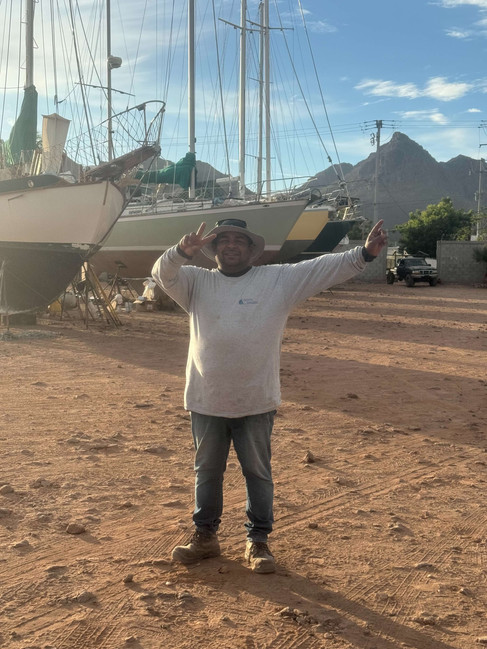
An adios to our hard-working boatyard friends.


Then we get the bottom wet.


Lily takes her usual spot (anywhere she can get where she is not restricted by the netting that is painstakingly strung up for her protection)

First stop, a tiny little anchorage a short 15-minute motor away that Jim has been wanting to try on Isla de Pajaros. It was a great little calm spot to spend a few days making sure there were no leaks and getting the rig tuned up. Here is our first sunset at anchor this season.

One still morning before moving on, we decided to take the dinghy to shore to investigate the multiple little beaches at this tiny anchorage, starting with the one furthest north.

It was a pleasant sunny day and the water wasn’t too cold in the shallows, so Lily went fish hunting.

As we leisurely made our way south paralleling the shore, we noticed a curious bright green growth on the water. As we approached to get a closer look, we noticed some bubbles on the water as well. Then it hit us (well, it hit me because Jim’s olfactory senses are not nearly as sharp as mine). It was as if we had just dropped into a sewer pipe! I gagged. I couldn’t breathe. Tears came to my eyes. But Jim and Lily were unaffected and wanted to continue to get in for a closer look. Finally, Jim was able to smell how awful it was and relented to my begging to turn away, so we never really got a close look. We hope that it was just some organic bloom or decomposition gassing off and not the exit to a sewer pipe from the mainland, but we will never know.

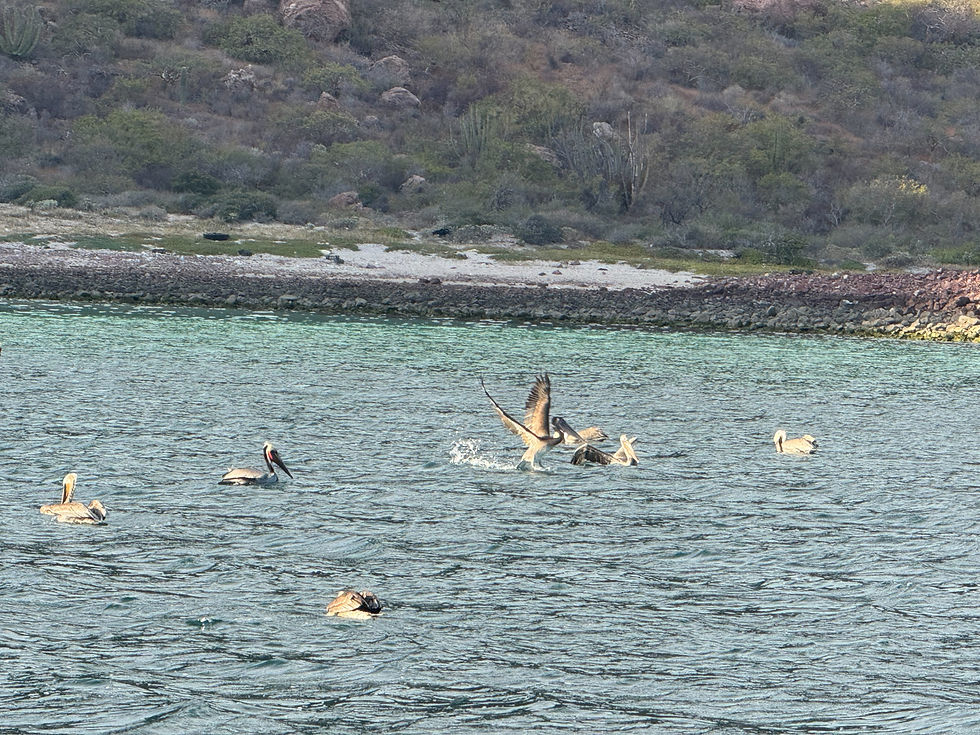
From there we moved about 2½ hours into Bahia Paraje Viejo (called Catalina by all of the gringo sailors), where we always anchor while awaiting a weather window for the 180-mile sail to Topolobampo. We always like to stay there for a few days because it is more open to the sea, so we get more boat movement for our bodies to adjust back to a constant state of motion, making it less likely to become seasick. We stayed much longer than we anticipated this time because somehow Jim ended up getting sick and fighting a respiratory infection for over a week. The biggest problem of that was that we blew through most of my fresh produce provisions before we even got started. While anchored in Catalina we were entertained by regular pelican feeding frenzies. I know the picture doesn’t look very frenzied, but trust me large groups of them would dive in to catch their dinner, then after swallowing take off to dive in again nearby for seconds.
Also, dolphins swam into the bay several times. They didn’t come up to the boat though. They were on a mission, hunting the same fish for dinner that the pelicans were eating I suppose.

Another interesting observation while hanging out on the hook was jellyfish. There were lots of long ropes (some 10-feet long, maybe 20-feet or longer if you stretched them out in a straight line), maybe ¼-inch in diameter of clear gelatinous goop surrounding an orangish-brown spot about the size of a lentil, at no more than ½-inch intervals. The structure held together, but didn’t withstand much pressure. We thought it may be some kind of jellyfish or jellyfish egg, even though there was no stinging sensation when touching it. Upon further research (thanks Google), we think they may have been Salps. If so, each spot we saw was a stomach. Salps are gelatinous zooplankton. They form chains by linking together and feed by pumping water trough their bodies. Fun fact: They produce large, fast-sinking, carbon-rich fecal pellets. Not only are they interesting, they are good for the environment!
But there were also jellyfish in the water. This was surprising as we have not previously seen them in the cooler winter waters here. We saw a variety that that was shaped like a feather with a pinkish hue. We also saw a variety about the size and shape of a quail egg that was completely clear except for one small dot of phosphorescence that looked like it was traveling along the outer edge longways. It was very interesting, and like the strings of Salps, I didn’t take a single picture.
As an apology for some pictures I didn’t take, here is one of many beautiful sunrises from the anchorage.

With Jim feeling better and our bodies fully adjusted to life at sea, we were ready to head south. We hauled up the anchor at first light, and hoisted sails under a light breeze.

As the sum began to rise, we could see a fog bank in the distance. It was pretty to look at, but we were hoping that it would burn off before we reached it.

Before we reached the fog, we were treated to a visit by a few dolphins who veered away from their breakfast-hunting pod momentarily to say hello. We never get tired of dolphins. They are always a joy and considered good luck for sailors.

We had several hours of slow but smooth sailing. It was a bit cold for my liking, as we were denied the warming rays of the sun once we entered the fog bank. However, it cleared up just in time for sunset—figures.

As you can see, once the sun was setting, the winds died and the waters became a pond. As we motored through the night, we were thankful that it wasn’t foggy. A mere 36 hours from the start, we were anchoring at the Santa Maria Hook just outside the channel to Topolobampo.


By the strangest of coincidences, I too produce large, fast-sinking, carbon-rich fecal pellets. What a small planet.
Sharing, it has been cold....minus one last week
Wonderful stories, thanks for sharin