


Pearls of Wisdom
- Jun 18, 2021
- 6 min read
Updated: Jul 12, 2021
While on our PC trip (that’s Pre-Covid) to Mexico in January of 2020, we decided to visit a pearl farm we’d heard about but never took the time to visit. We had a tough time finding it as it was tucked back at the end of the road behind a residential community. It is quite a grand building by a scenic bay on the Sea of Cortez.

History of the Sea of Cortez Pearls
The glory days of the “Cortez Pearls” were in the early 1600’s. When the Spanish Conquistadors first came to Sonora, Mexico they saw that the Seri and Yaqui Indians had elegant and unique pearls. At first they traded with them for the pearls, but like any world conqueror they soon began fishing for pearls themselves utilizing slave labor. By the late 1800’s the Spaniards had exhausted the oyster beds around Guaymas and moved on to the Baja Peninsula. But it wasn’t until 1940 when the Mexican government issued a ban on all pearl fisheries.
In 1991, some University students in Guaymas began experimenting with the local Rainbow Lip Pearl Oyster. What began as a class project (which received a C grade because the teacher told the students that farming Sea of Cortez oysters was impossible according to several Japanese text on the subject), has become a 300,000 oyster “farm” producing over 8000 pearls a year—and growing.
What’s So Special About Sea of Cortez Pearls
Most pearls around the world are “embellished” by bleaching, burning, polishing, or applying lacquer, while the Cortez Pearls are simply rinsed in tap water after being removed from the oyster. They are unique because of their color. They come in many iridescent colors like the insides of the Rainbow Lip Oyster’s shell.

There are two types of Cortez Pearls. Round loose pearls like these

And Mabe Pearls (half of a round pearl that are like “blisters” on the shell that is cut out for jewelry) like these:
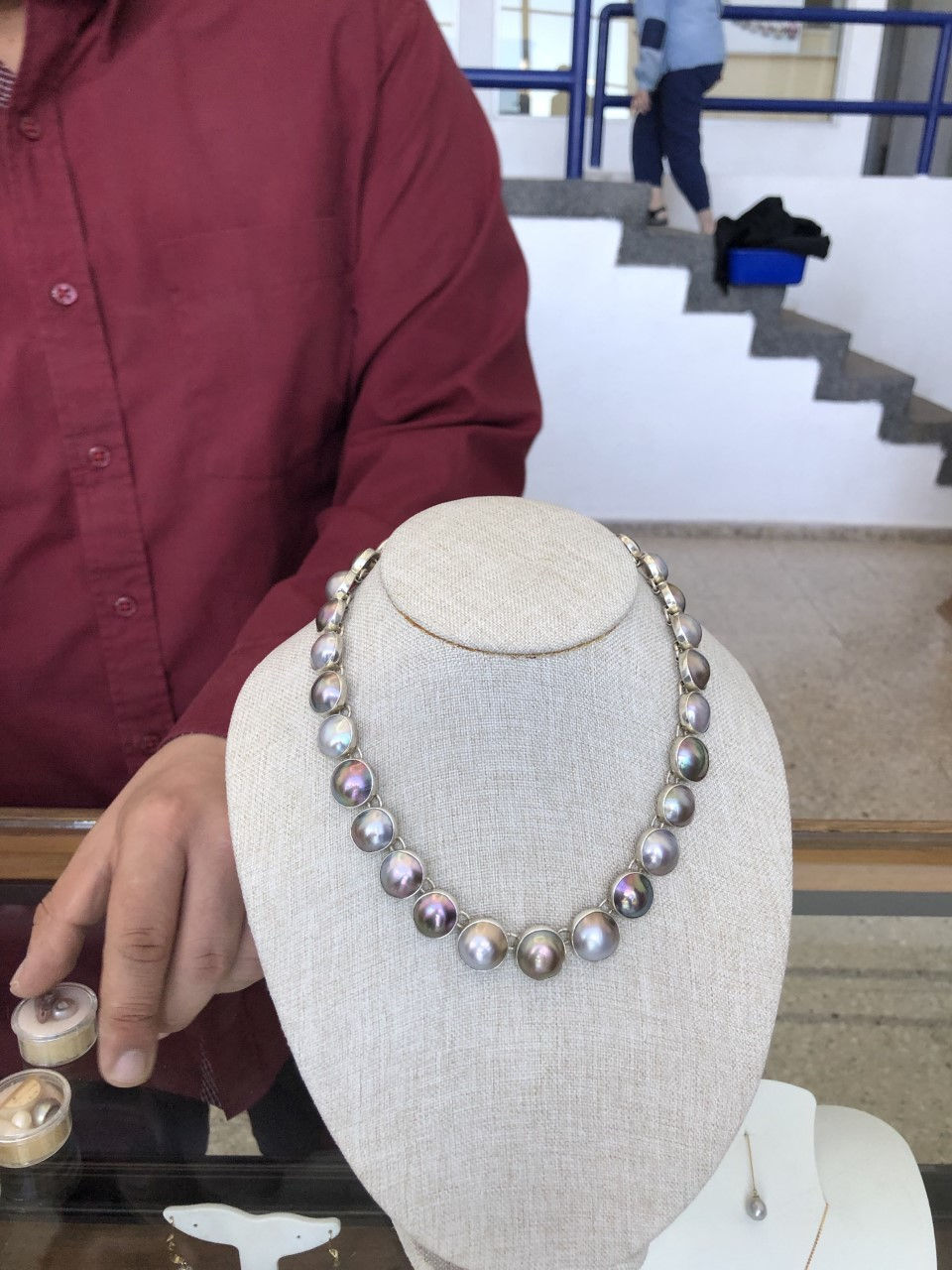
Mabe pearls are not as rare as loose pearls, but it still takes a very long time to get enough pearls of similar size, shape, and color to make a necklace.
Another special thing about the Cortes Pearl is how thick the outer layer or natural pearl part is. Many types of pearls are perfectly round and all the same size. This is because there is only a very thin layer over the perfectly round bead, while the Cortez Pearl has a much thicker natural outer layer. The thickness of the Cortez Pearl also makes it rare to nearly impossible to have perfectly round or perfectly sized pearls as each oyster grows a unique pearl.
How to Make a Pearl
When we visited the pearl farm in late January, it was baby oyster season. Since they have not figured out how to reproduce oysters in the lab, they have to collect them from the sea. Our fabulous and knowledgeable “tour guide” Fernando told us that when the Rainbow Lip Oysters are babies their shells are soft and everything in the sea likes to eat them (like starfish and octopus). He called them the Cheetos of the sea. There are lots of them just floating around in the water looking for a place to attach themselves for safety (like on fan coral). So they simply scoop up the sea water to collect the baby oysters.

Then they clean each baby and put them inside a bag of wadded up fishing net (which resembles the fan coral where they might naturally try to find safety), and put them back into the water to grow.
Dirty oyster

Clean oysters


Tedious job of cleaning baby oysters all day

These are the green bags for the babies. As they grow they move them to the triangular and circular cages.

They pull them out frequently to clean them. Why would an oyster need a regular bath?! Apparently, when barnacles grow on them it can kill them by keeping them from being able to open and close properly for feeding. Here is an example of an oyster “teenager” with barnacles.

This is the size at which they move them from the net bag into the cages. (Interesting fact: They have a very difficult time keeping the octopus out of the cages and have no idea how they get into them!)
Here Fernando is holding a diagram of the inside of an oyster. At the bottom of the diagram is the lip flap where the mabe pearl is made. They lift the flap and super glue (yes, they have found that super glue holds much better than surgical glue), half a bead under it.

If the oyster can’t get it out (about 20% of the time they do spit it out), it will grow nacar over the bead. Nacar is the colorful iridescent part inside the shell that makes pearls beautiful—yes, I believe that is the technical definition. Here is what it looks like.

As you can see, even the successfully implanted beads don’t always grow to the shape they are looking for to be of jewelry quality. This is also an interesting example, because you can see on the left a worm-like blister where a parasite had entered the oyster. Parasites can kill an oyster, and their natural defense against them if they can’t spit them out is to grow the nacar over them.
Not all oysters are created equally. To make the mabe pearls they use the oysters that are thin with long flat lips. They use the oysters that are fat in the middle to make the round loose pearls because they grow under the oyster’s stomach. That is the yellow part of the oyster in the previous diagram (it’s only yellow in the diagram not in the oyster). I knew a pot belly was good for something—like growing beautiful loose pearls!
When they first started trying to make round pearls, they tried filling the oysters with sand. They thought that pearls were made from a grain of sand—who doesn’t? I know I did. But, the oysters just spit all the sand out. Then they realized that the natural pearls in the Rainbow Lip Oyster were made from those nasty little parasites being covered over in nacar. This is why most natural pearls are mostly worm-like shapes. Here is a picture of a natural pearl and a cultured pearl cut in half.

So, to make the loose pearl they developed a surgery where they carefully cut a tunnel under the oyster’s organs to place a small bead and a skin graft of that nacar under the oyster’s stomach. We were lucky enough to see this being done, but were not allowed any pictures during the process to protect their secrets—there are only 3 people who know how to do it, (that’s 3 guys for over 300,000 oysters a year).
Oysters get their bead at about 2 years old. After removing the oyster from its cage and cleaning it, they put a small wedge in the shell for the surgery to prevent it from closing up when they cut them. The oyster shells are initially open because they are calm and used to being handled. The tunnel is cut and the bead, graft, and some antiseptic is placed under the stomach in a process that only takes about 45 seconds! About 80% of the oysters are able to spit out the bead and will have no pearl inside.
After receiving their bead, the oysters are sewn into nets (they called them oyster condos), and put back into the sea. For the next 2 years they will be taken out weekly to be cleaned.
Tools you will need for oyster surgery:

Post-surgery oysters


Post-surgery oysters being sewn into nets (oyster condos)

At 4 years they harvest the oysters for the pearls and sell the meat to local restaurants. (Another interesting fact: the first pearl found in the oyster once they start harvesting, no matter how big, how perfect, or how beautiful, always gets thrown back into to sea) They have tried waiting longer than 4 years to see if they could get bigger pearls, but by 4 ½ years the natural life cycle of the oyster is over and when the oyster dies it loses its pearl.
Here is where they clean the oysters

"The Farm"




An alter to the pearl gods

So, it takes 2 years to grow an oyster big enough to surgically insert a small mother of pearl bead into it. Then another 2 years to grow a pearl while cleaning all the growth off of them weekly to keep them healthy. Then only 20% actually have a pearl. Wow! That seems like a lot of work…
We hope you enjoyed learning about the Cortez Pearl. Next stop…Nacapule Canyon


Comments