


Topolobampo?...TopoloBUMPo!
- Feb 20, 2022
- 6 min read
This is the second time we have sailed south down the mainland coast of Mexico. It is more common for sailors to cross over to the Baja side because the mainland’s offerings of safe anchorages are fewer and further apart. Additionally, some of those anchorages are tucked back inside some serious sand bars and shoal necessitating a long motoring through a dredged-out channel which is something many are not interested or willing to do. We quite enjoyed Topolobampo on our first visit there, but we didn’t stay long, so it was always in the back of our minds to go back and take a little more time to look around. We anchored in Bahia Santa Maria out in front of some sand bars that extend off the mainland about half-way through and just outside the main channel into Topolobampo. There are no structures on the bar, but we did notice some cows and donkeys roaming about.
It had been quite some time since we had been on shore, and we were excited about exploring the sand dunes, but our first order of business after securing anchor was sleep. (This is always the case after long passages. Even though we take turns at the helm so that the other can get some sleep, it is often difficult to get much rest while under way.) It took several days before we were able to get to shore. First it was too windy (we don’t have an outboard for our dinghy, so we have to plan our rowing to shore carefully to make sure we can make it past any surf without getting swamped and then back to our boat without being swept out to sea). Then there was some rain.

But finally the right conditions presented themselves, and we were able to go exploring. The dunes were spectacular, and it was great to get to stretch our legs out—for all of us.





I kept trying to get close to this great heron on shore, but (much to the annoyance of the heron), Lily must clear the beach of all “dangers” before I come near.


Then it was time to hoist up the anchor and motor ?? more nautical miles down the channel to spend a few nights at the marina. There we had enough cell signal and wifi to communicate with our family and friends, were able to fill our tanks (water and fuel), and have hot showers (delightful). While at the marina we took some time each day to walk around the town of Topolobampo.
They have many lovely sculptures throughout the town.


We found a nest on a nearby power pole (perhaps a mating pair of osprey?)


The ship channel ends right along the Malecon. It is not very wide, and we got to watch a pair of tugboats spin a ship around—one to pull and one to push.


Beautiful pelicans


I finally got a close-up of a great heron on the docks at the marina


We spent three nights in the Marina, then headed back out to anchor for one night with plans to head directly to Mazatlan under predictions of light winds and calm seas.
Back story: He Said, She Said
Our first time navigating to Topolobampo through the channel, I was at the helm with Jim, the captain, helping spot the red and green buoys that mark the channel. (I’m not sure why we were not using any of our GPS navigation at the time?) You should know that many of the channels in Mexico are notorious for not being very well marked, and the charts and depths are equally outdated and inaccurate—particularly in less visited places. This being said, it is worth mentioning that Topolobampo is fairly well marked with navigation buoys. So, the story Jim likes to tell is that I ran aground going into Topolobampo. This is technically true, however, I like to add the circumstances surrounding my getting temporarily stuck on the sand. We were both seeing different buoys. The one I was headed for was the closest and correct one. Jim was seeing the next set further off after the channel doglegs to the left. We were bickering about which direction to head, but in the end I followed my captain’s orders, veered left, and promptly bumped the bottom, plowing our full keel into the sand. He said: you were at the helm, she said: but I was following my captain’s directions—you can be the judge.
So, back to leaving the marina which sits at the end of a smaller channel off the main channel. We say our goodbyes to the Omars (the same two employees that worked the docks last time we visited and who both happened to be named Omar); while I pull our fender out of the water, Jim is at the helm heading towards the channel. He thought that there was a shallow spot off to his port, so he swung wide to starboard where he made short work of digging our keel into the sand. This incident will perhaps give Jim pause before telling of the first time we got stuck in Topolobampo.
It should be said that running aground is not that big of a deal, especially on the sand and if done correctly—after all, for many years some of the saltiest sailors have run aground and waited for the tide to go out to clean or paint the bottoms of their boats then waited for the tide to come back in to become afloat again. And while we have run aground more times than we care to admit, we aren’t Laurel and Hardy out here bumbling around. Knowing that sands shift faster than charts are updated and channels are dredged, we always move on a rising tide. This way we are never officially stuck (on a high tide), only temporarily delayed as we await the tide to rise and float us off the bottom.
We were perfectly happy (though also embarrassed), to sit on the bottom for a couple of hours if necessary to become afloat; however, a panga fisherman going by noticed we were stuck and came to help. We were appreciative of his kindness and accepted his help. After about 20 minutes trying to pull us off the bottom into deeper water (he didn’t have a very powerful outboard), there was a communication error and the rope we had given him to tow us with ended up being jammed up into our propeller shaft effectively disabling our engine. While trying to cut away all rope a second panga fisherman and his young son came over with a more powerful outboard to help as well. They got enough of the rope from the prop and shaft so that it moved freely enough for us to use our engine, then returned to pulling our 10-ton boat off the bottom, (I went to rope duty to make sure that no rope got near the prop and inform Jim when a rope went slack so he could cut our engine). They did eventually pull us over to deeper waters (perhaps with additional help from the rising tide), and we insisted they take some money for their fuel, time and efforts. Once at anchor Jim spent another hour and a half removing the rest of the rope that had jammed into the shaft. (this is not the panga fishermen that helped us, just a cool picture of panga fishermen at work)

The next day we hauled up the anchor, motored to the end of the channel, turned south, then hoisted up our gennaker (a big light wind sail) sailing towards Mazatlan.
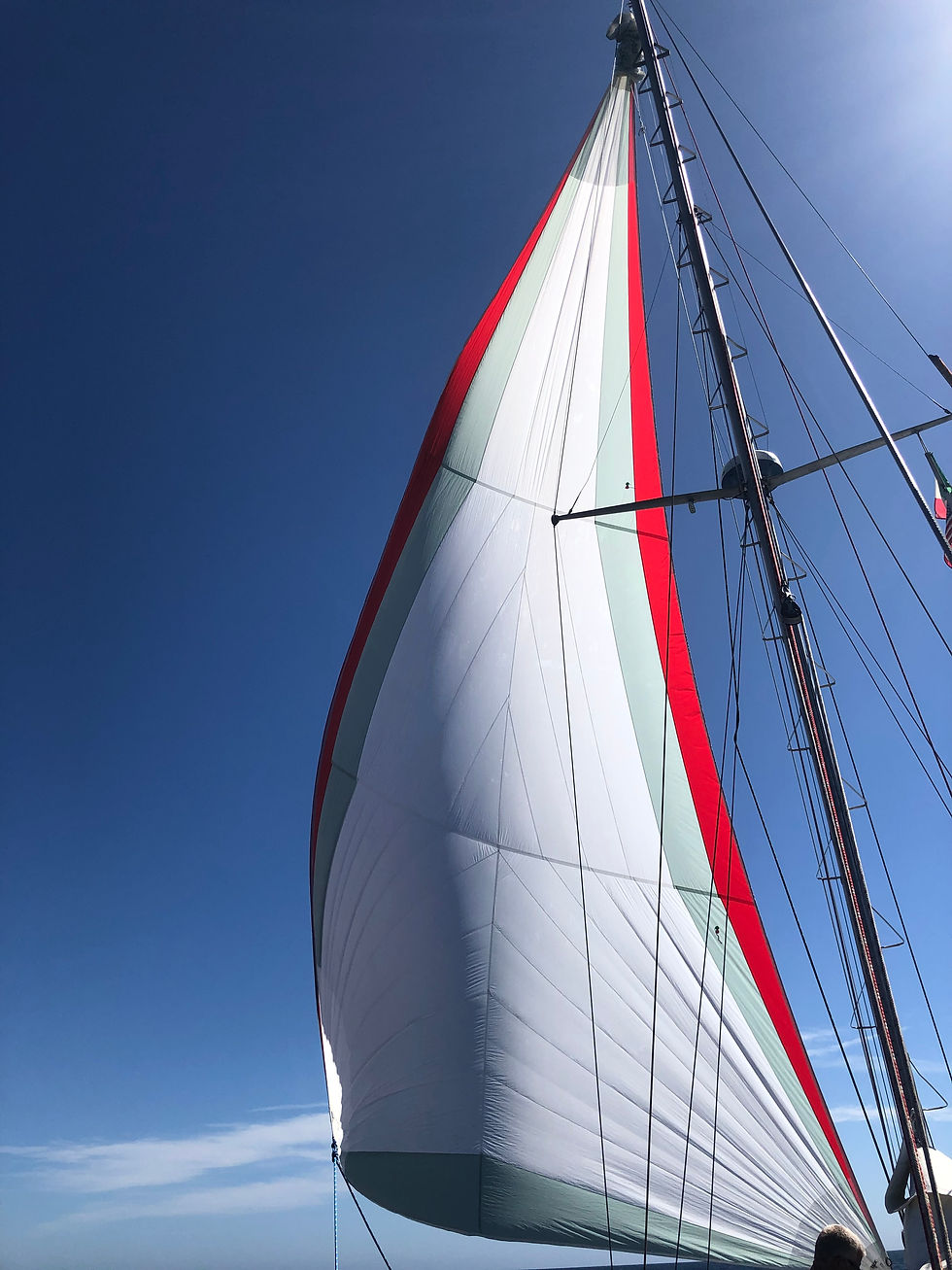
It was smooth sailing for about 8 hours when the wind died down and we had to crank up the engine. As it turns out we had to motor most of the way—but no wind and calm seas is better than the alternative! The closer we got to Mazatlan (out of the Sea of Cortez and into the Pacific Ocean), the more comfortable the ride was. Once in the ocean, the sea swell became more consistent, further apart, and mostly from one direction. With the lack of wind, the ocean became like a pond and perfect for spotting sea turtles sunning on the surface. We also spotted some whales breaching and spouting (too far away for pictures), as well as a few more dolphins. It took us just about 48 hours to get to Mazatlan. We anchored in the south harbour where here we still sit with no concrete plans for leaving…yet.
sunset at sea


Comments